What happened when I optimised my homepage for local SEO
I’ve recently gone self-employed as a small business marketing consultant and, at the weekend, I thought it was finally time to update my website to reflect what I am now doing, who I help, and where I’m based.
I figured if I am advising clients on SEO and AI visibility best practices, then I need to practice what I preach. ☺️
Within 2 days of making the changes, my website went from not appearing at all for my target searches, to featuring on page one of Google for two of my target local searches. It was also cited prominently in Google’s AI Overview.
I will caveat this to say that these are early results and rankings can, and likely will fluctuate. SEO is an ongoing process and I will be checking in over the coming weeks and monitoring the changes. I also made sure to check the results in a private browser and from a different IP address as well, as these things can influence the results.
In this post, I’ll explain what I did to achieve this and why, as well as some practical takeaways for other small businesses.
Prefer to watch? Here’s the quick version of the story and the early results.
A quick overview of why I optimised my homepage for local SEO, the early search results and what the experience showed me about SEO and AI visibility.
Why my homepage needed changing
As someone with expertise in SEO and digital marketing, my homepage had been bugging me for a while. I knew it wasn’t optimised as well as it could be for what I’m now doing, and I knew the importance of it, but I hadn’t had chance to update it.
Previously, I was mostly creating educational marketing courses for small businesses via Skillshare, and I’ve only recently started to offer marketing consultancy services. So, I wanted to make sure I was visible on Google and in AI search for people who may be searching for such marketing services in my local area of Cheshire. And, spoiler alert, I wasn’t! 🫣
To start fixing this, I looked first at my homepage and spotted a few issues straight away:
Now, the H1 title on a webpage is important for SEO, but the H1 title on my homepage wasn’t optimised at all. It said ‘helping small businesses feel clear and confident in their marketing.’ Now that wasn’t bad, as it was the outcome of what I was offering, but it didn’t immediately identify me as a marketing consultant or strategist, or include my location or audience. I needed to amend this so that Google and AI search tools knew exactly what I did, where I am and who my audience is.
My location wasn’t prominent on my site. I didn’t mention where I was based anywhere on my homepage or site. This meant that search engines wouldn’t know either, and I would be unlikely to show up in local searches. This was intentional at one point but, it definitely needed attention if I wanted to grow in my local area (Cheshire, UK!)
The intro copy on my homepage was way too long and waffly, pushing the enquiry button lower down. The copy was also not optimised for what my target audience would potentially search for.
My marketing services and tailored support needed better signposting with internal links. Internal links are important for SEO and also for the audience, so they know where to find things. It was also not obvious what my services were from the homepage, so this needed attention right away.
The homepage needed more trust signals - such as testimonials, or why should someone choose to work with me? I had trust signals on my site, but they weren’t obvious.
I also spotted that the homepage title, SEO title and meta descriptions were all out of date and didn’t really say what I did or where I was located.
What I wanted my homepage to achieve
The homepage of a website is important for SEO because it helps visitors, search engines and AI-powered tools understand what your business does, who it helps and where it’s located. Mine had become a little messy, and it wasn’t immediately clear what I actually offered. If my positioning wasn’t clear to a potential customer, it was unlikely to be clear to search engines or AI tools either.
By optimising my homepage, I wanted to:
Clearly position myself as a marketing consultant and strategist
Explain that I work primarily with small businesses and solo founders
Strengthen my relevance for searches in Cheshire
Communicate my mix of strategy and hands-on marketing support
Make my services easier to understand and explore
Shift the emphasis from promoting courses to attracting consultancy clients
Help search engines and AI-powered tools understand my expertise
Encourage more relevant enquiries from potential clients
The aim was to make the positioning clearer, more focused and more useful for everyone arriving on the website.
The keyword research
Before making any changes, I researched the terms I wanted my website to appear for. I used Ubersuggest to compare factors such as estimated search volume, SEO difficulty and the likely intent behind each search.
The terms I considered included:
Marketing consultant Cheshire
Marketing strategist Cheshire
Small-business marketing consultant
Marketing consultant
Marketing strategist
The broader terms had higher estimated search volumes, but they were also more competitive and less specific. Someone searching for “marketing strategist” could be looking for a definition, a job or a consultant located anywhere in the country.
I therefore decided to focus initially on the Cheshire-based searches. Local keywords often have lower search volumes, but they can also have clearer commercial intent and less competition than broad national terms.
A person searching for a “marketing consultant Cheshire” is likely to have a much more specific requirement, and could be more relevant to my business, than someone making a general search for “marketing consultant”.
Keyword research isn’t about choosing the phrase with the largest number of searches. Relevance, intent and the likelihood of reaching the right potential client matter just as much as search volume.
What I changed on the homepage
Once I had decided on my positioning and target keywords, I worked through the homepage section by section. The aim here wasn’t to just add more keywords. I wanted the entire page to give visitors and search engines a clearer, more consistent picture of my business.
I optimised the main H1 heading
My previous homepage heading was: Helping small businesses feel clear and confident in their marketing
I still liked the sentiment behind it, but it didn’t clearly explain what I did or where I was based. It could have applied to a coach, course creator, agency or marketing consultant.
I replaced it with: Small business marketing strategist in Cheshire
The new heading immediately communicates three important things:
My audience: small businesses
My service: marketing strategy
My location: Cheshire
It may be less creative than the previous version, but it is much more useful. Someone arriving on the page can quickly decide whether my services are relevant to them.
Why is the H1 important?
The H1 is normally the main visible heading on a webpage. It helps visitors understand what the page is about as soon as they arrive and gives search engines an important indication of the page’s primary topic.
Headings also create a clear hierarchy. The H1 introduces the overall subject, while H2 and H3 headings divide the content into related sections. This makes longer pages easier for people to scan and helps search systems understand how the information is organised.
Although an H1 alone won’t make a page rank, a vague heading can be a missed opportunity
I added an eyebrow line
Above the main heading, I added:
Cheshire-based marketing consultant and strategist
This is known as eyebrow text: a short line of supporting copy placed above the main heading.
It allowed me to include the phrase “marketing consultant” alongside “marketing strategist” without trying to force both terms into an overly long H1. It reinforces the overall topic of the page while keeping the main heading focused and readable.
I shortened and focused the introduction
The previous homepage introduction had become long and repetitive. It spoke about marketing overwhelm and confidence, but took too long to explain what I could actually help with. I reduced it to three focused paragraphs:
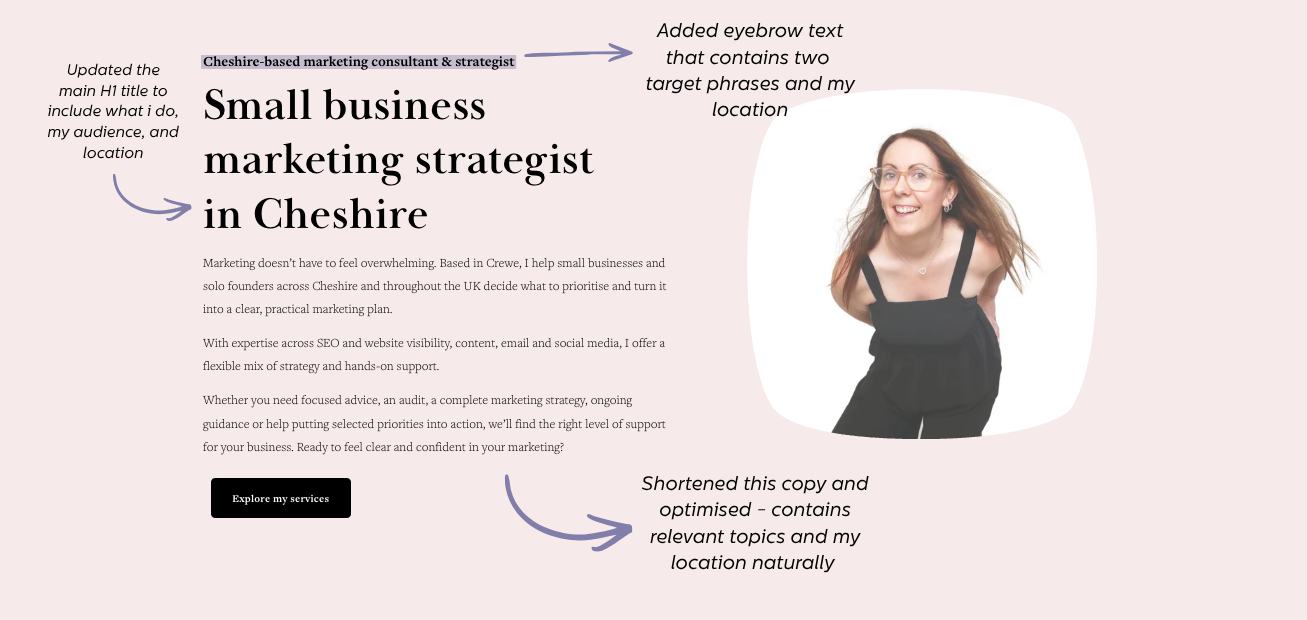
The key homepage changes: a clearer H1, supporting eyebrow text and shorter copy focused on my services, audience and Cheshire location.
This version still sounds like me, but it communicates much more information in less space. It identifies who I help, names some of my main areas of expertise and explains that I can provide both strategic guidance and practical implementation support. I included relevant topics such as SEO, content, email and social media naturally. I didn’t want the introduction to read like a list of keywords or try to include every service I offer.
I updated the page and search information
I also reviewed the information that may appear in browser tabs and search results, including the page title, SEO title and meta description. I updated the SEO title to:
Small Business Marketing Consultant in Cheshire | Louise Laurie
This places my audience, service and location prominently while still including my name.
I changed the meta description to:
Cheshire-based marketing consultant and strategist helping UK small businesses simplify their marketing, build a clear plan and grow with confidence.
This gives potential visitors a quick summary of what I do and who I help before they click through to the website.
Meta descriptions aren’t a direct ranking factor, and Google may sometimes display different text depending on the search. However, a clear and relevant description can help people understand what they’ll find on the page and encourage more suitable visitors to click.
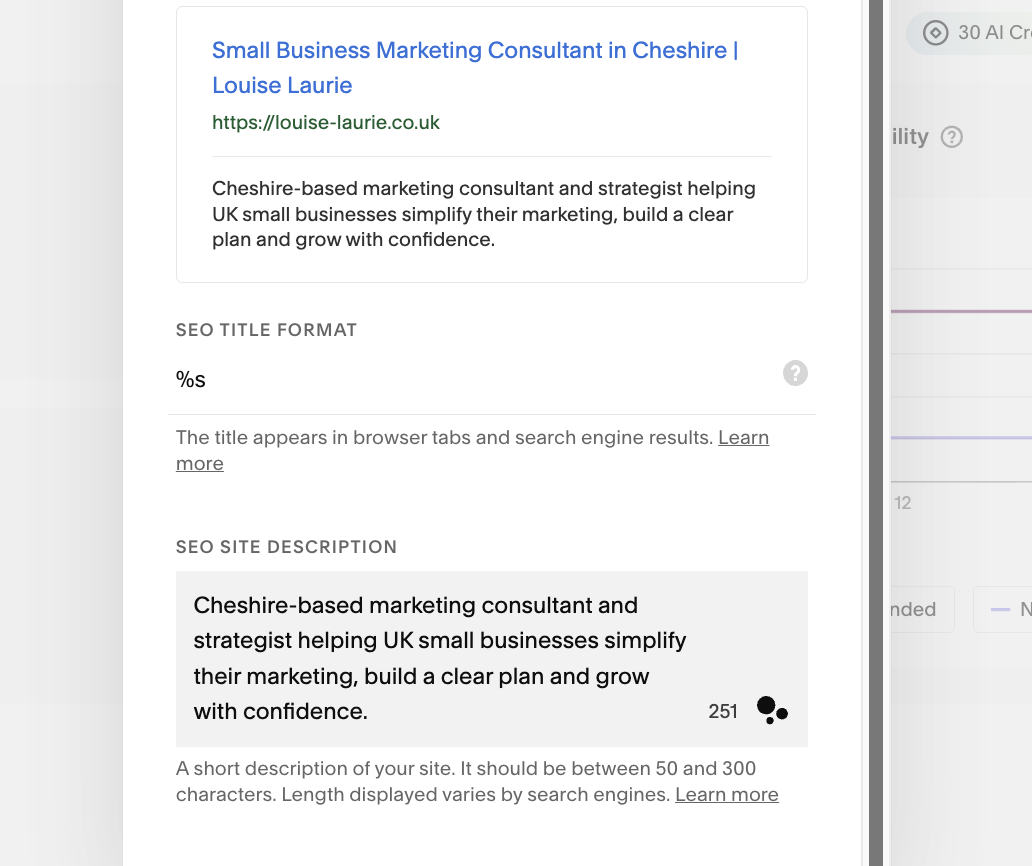
My updated homepage SEO title and meta description in Squarespace.
I improved the service structure
I reorganised the service section so visitors could understand the different ways we might work together.
I grouped my support into clear categories:
Focused advice and clarity
Audits and tailored strategy
Ongoing support
This made the choices easier to scan without presenting them as rigid, one-size-fits-all packages.
I also explained that the options are examples of how we can work together. The precise scope can be tailored around the client’s goals, priorities and available resources.
Each category now directs visitors towards my full marketing services page, where they can learn more about focused sessions, audits, strategy projects, training, fractional support and implementation.
I strengthened the credibility signals
I wanted potential clients to understand not only what I offer, but why they might trust me to provide it.
I made my experience and credentials more prominent on the homepage, including:
More than 15 years of marketing experience
My MSc in Digital Marketing Communications
My CIM membership and teaching work
My experience as a Skillshare Top Teacher
The number of students I have taught
Relevant client testimonials

I made my experience, qualifications and teaching credentials easier to spot on the homepage.

Client feedback adds real-world evidence of the practical, tailored support I provide.
I also created a clearer “Why work with me?” section. This explains my practical approach, the benefits of working with an independent consultant and how my recommendations are tailored to each business.
These additions are useful for potential clients, but they also give search engines and AI-powered tools clearer evidence of my experience and areas of expertise.
I improved the local signals
Because I wanted to become more visible for relevant searches in Cheshire, I added my location naturally across the website.
I included references to Crewe and Cheshire in appropriate places, including:
The homepage
My marketing services page
My “Why work with me?” and about content
The contact page
Relevant FAQs
The website footer
I didn’t add the location to every heading or repeat it unnecessarily, as this can come across as spammy and you want your site to be easy to read for humans as well as search engines and AI tools. The goal was to make it consistently clear where I’m based while also explaining that I work remotely with businesses across the UK.
I improved internal links and calls to action
I reviewed where the homepage directed visitors and added clearer links to important parts of the website.
These included links to:
My marketing services
My about page
Relevant marketing articles
My enquiry page
I also changed some of the calls to action so they described what would happen next. Phrases such as “Explore my services” and “Tell me about your project” are more specific than a generic “Learn more” button.
Internal links help visitors navigate the website, but they also help search engines discover related pages and understand how the different topics and services connect.
I requested reindexing through Google Search Console
Once the updated homepage had been published, I used Google Search Console to inspect the URL and request indexing.
This doesn’t guarantee that Google will rank a page, and repeatedly submitting the same URL won’t push it higher in the results - but it alerts Google that the page has changed and requests that it be crawled again, so it’s worth doing.
After submitting the request, the next step was to wait and monitor what happened.
The early results
I published the revised homepage and requested reindexing through Google Search Console. Within days, I began appearing on the first page of Google for:
Marketing consultant Cheshire
Marketing strategist Cheshire
Cheshire marketing strategist
I checked the searches using a private browser while located in Cheshire. Private browsing removes most personal search-history signals, although location and other contextual factors can still influence the results someone sees.
My website was also cited prominently in Google’s AI Overview for “marketing strategist Cheshire”.
In the AI-generated answer, Louise Laurie was named first among the notable regional providers and appeared first under the “Independent Strategists & Consultants” section. My homepage was also displayed as the leading source card alongside the overview.
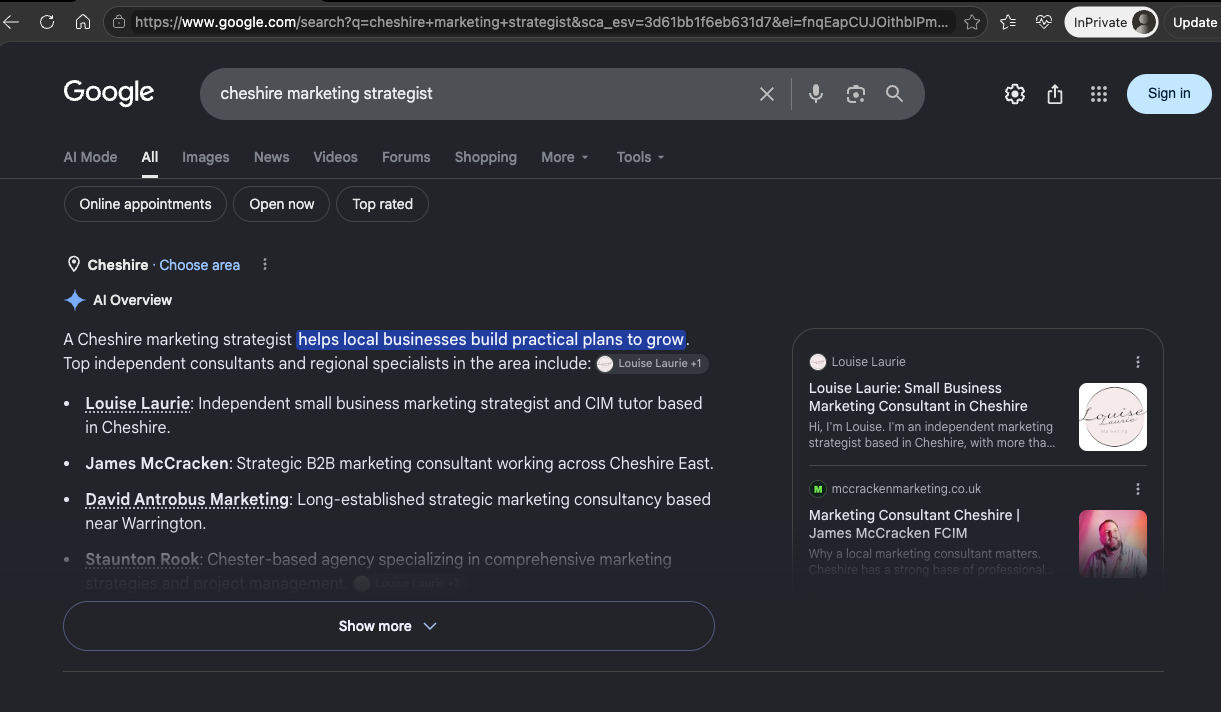
On 18 August 2026, Google listed me first among the independent consultants in its AI Overview for “Cheshire marketing strategist”, with my updated homepage also appearing in the organic results.
These results were recorded on 18 August 2026, within days of the homepage update. Now, search results vary according to location, device and other factors, and rankings can change over time. AI Overview answers and cited sources can change too. I’m therefore treating this as an encouraging early result rather than evidence of a permanent ranking position. It is still a valuable indication that Google understood the revised positioning and considered the website relevant to the searches I had targeted.
Why I think the changes worked
It would be misleading to claim that changing one heading caused the website to reach page one. The site was already established, indexed and contained a substantial amount of marketing-related content. Google already knew the website existed and had previous information about its overall subject.
I think that the update helped to connect those existing signals more clearly. The revised homepage made my service, audience and location more clear. The SEO title, H1, introductory copy and supporting sections all communicated a consistent topic without repeating the same phrase unnaturally.
The supporting pages also reinforced this positioning. My services, about content, FAQs, contact information and footer provided consistent references to my experience, location and the type of businesses I support.
Other factors that may have contributed include:
A clearer homepage topic
More specific service descriptions
Consistent references to Crewe and Cheshire
Stronger internal links between related pages
Prominent experience and professional credentials
Testimonials and other trust signals
An established website with existing relevant content
Target searches that were specific and realistically competitive
The important point here is that the homepage didn’t work in isolation. It became a clearer summary of information that was also supported elsewhere across the website.
What this shows about SEO and AI visibility
One of the most interesting outcomes was appearing in both traditional search results and Google’s AI Overview. SEO and AI visibility are sometimes discussed as though they are completely separate disciplines. In practice, many of the underlying principles overlap.
Search engines and AI-powered tools both need to understand:
What a business does
Who it helps
Where it operates
What expertise it has
Whether its content is useful and credible
How different pages and topics relate to one another
Clear positioning helps potential customers, but it also makes information easier for search engines and AI tools to interpret. Helpful, specific content can provide useful material for AI-generated answers, while consistent information across a website can give systems greater confidence about the business and its areas of expertise.
This emerging area is sometimes called generative engine optimisation, or GEO. However, AI visibility shouldn’t be treated as a separate guaranteed trick. There is no switch that makes a website appear in AI-generated answers, and inclusion can change from one search to another. The best starting point remains a useful, technically accessible website with clear positioning, credible expertise and content that genuinely answers the audience’s questions. This will give you much more chance of appearing in these answers.
There’s still more I can build on
Updating the homepage was an important first step, but SEO is never really a one-and-done job. I’m fully aware that there are plenty of other ways I can continue strengthening my visibility and giving potential clients more confidence in working with me.
My next steps include:
Adding more client reviews and testimonials
Creating case studies that demonstrate the work I’ve completed and the results
Developing dedicated pages for important services
Publishing useful content around the questions my audience is searching for
Strengthening internal links between related services, articles and resources
Building more relevant local and industry mentions
Keeping business information consistent across the website and other online profiles
Case studies and reviews will be particularly useful because they give potential clients real examples of what it’s like to work with me. They can also provide search engines and AI-powered tools with more context about my experience, services and areas of expertise.
What I’ll monitor next
Over the coming weeks and months, I’ll continue optimising, adding content, and monitoring performance through Google Search Console and other relevant checks. In particular, I’ll be looking at:
Impressions for the target searches
Other queries that begin triggering the website
Average ranking positions
Clicks through to the homepage
Changes in organic website traffic
Relevant enquiries
Whether the initial rankings remain stable
Whether related local searches begin appearing
Continued inclusion in AI-powered search results
I also want to understand whether improved visibility results in meaningful business outcomes. A page-one ranking is encouraging, but attracting relevant visitors and enquiries is more valuable than the ranking alone. I plan to review the data after approximately six to eight weeks. This should provide a more useful picture of whether the early visibility developed into a sustained improvement. I may update this article once enough data has accumulated.
Practical lessons for other small businesses
Remember that you don’t always need to redesign your entire website or publish dozens of new articles to improve your online visibility. Sometimes the first step is making your existing website clearer. It’s also a reminder not to neglect your site - even a few quick tweaks can make a big difference to your visibility.
If you’re reviewing your own homepage, consider the following questions:
Can visitors immediately understand what you offer?
Is it clear who your service or product is for?
Is your location included where it is genuinely relevant?
Does every important page have a clear purpose?
Do your SEO title, H1 and introductory copy support the same main topic?
Are your services easy to find and understand?
Does the website demonstrate genuine experience and credibility?
Do related pages link to one another?
Are your calls to action clear about what happens next?
Are you measuring search performance through Google Search Console?
You don’t need to place your exact keyword in every paragraph. It’s always better to aim for clarity and consistency rather than repetition, as your website needs to be easy for people to read as well as search engines. If a potential customer can quickly understand what you do, there is a much better chance that search engines and AI-powered tools can understand it too.
One additional tip for local businesses
If your business serves customers face-to-face, either at your premises or by travelling to them, a Google Business Profile can also support your local visibility and is great for SEO.
Make sure you keep your business information accurate, select genuine service areas and encourage customers to leave honest reviews.
Frequently asked questions about homepage SEO
Why is the homepage important for SEO?
Your homepage usually provides the clearest summary of your business. It helps visitors and search systems understand what you offer, who you help and where you work. It also directs people and search engines towards your most important services and content.
How quickly can homepage SEO changes affect rankings?
There is no fixed timescale. Some changes can produce early movement, particularly when an established website is targeting a specific, less competitive search. Other improvements may take several weeks or months to have a measurable effect. My results appeared unusually quickly, so they shouldn’t be treated as a typical or guaranteed outcome.
Should a small business target local keywords?
Local keywords can be valuable when location is relevant to the service and the customers you want to attract. They often have lower search volumes than broad national terms, but the people using them may have a clearer and more commercially relevant requirement.
Can an optimised homepage appear in AI search results?
It can, but inclusion is never guaranteed. Clear positioning, helpful content, a logical structure and credible evidence of experience can make a website easier for AI-powered search systems to understand and reference.
Should I request indexing after updating my homepage?
Google will usually discover updated pages through its normal crawling process. However, after making significant changes, you can inspect the URL and request indexing through Google Search Console. This can help Google discover the update, but it doesn’t guarantee when the page will be crawled or how it will rank.
Want to make your website easier to find and understand?
Sometimes, when you’ve spent so much time working on your own website, it can be difficult to see what’s clear, and what might be confusing potential customers, search engines or AI tools.
If you’d like a fresh pair of eyes, my SEO & AI Visibility Audit can help. I’ll look at what’s working, what could be holding you back and where your best opportunities might be. You’ll receive friendly, straightforward feedback and clear priorities shaped around your business, goals and available resources.
The visibility I achieved is still an early result, and I’ll continue monitoring it over the coming weeks. But it has already shown me what can happen when your website, positioning and target searches all begin telling the same story. If you’re reviewing your own homepage, start with one simple question:
Could someone understand what my business does, who it helps and why it is relevant within a few seconds?
If the answer isn’t an immediate yes, that may be the best place to begin.
– Louise
P.S. Don’t forget to:
🔍 Find out about my SEO & AI Visibility Audit
📩 Grab your free GEO guide
💌 Sign up for my newsletter for regular, practical marketing tips
📸 Follow me on Instagram for marketing updates and inspiration