
If you run a small business, you’ve probably seen plenty of posts about how AI is changing search, and you might be wondering what you’re actually supposed to do about it.
Does your website need to change? Is it still worth writing blog posts? And how do you get your business to appear when someone asks ChatGPT for a recommendation?
There’s a lot of information out there, and with terms like AEO and GEO being added to the mix, it can feel like there’s a whole new area of marketing you need to get your head around when you already have enough to do.
I recently delivered a webinar for Oxford College of Marketing about SEO and AI search, looking at what’s changing and what businesses should focus on. One of the main things I wanted people to take away was that, although we do need to understand how search is evolving, we don’t need to panic or throw out everything we already know about good SEO and marketing. SEO is still important and is very much the foundation needed for AI search visibility.
If you’re wondering what all this means for your business, read on to find out how I’d approach it.
How is AI changing the way people search?
For a long time, searching online generally meant typing a few words into Google, looking through the results and clicking on a website to find what you needed. We can still do that, of course, but AI-powered search gives us more ways to ask questions, explore options and get recommendations, with some of that research now happening within the search experience itself.
For example, someone might previously have searched for “marketing consultant Cheshire”, whereas now they can explain more about their situation:
“We’re a small business in Cheshire and need help with our website and content, but we don’t have an in-house marketer and don’t want a full-service agency. What kind of support should we look for?”
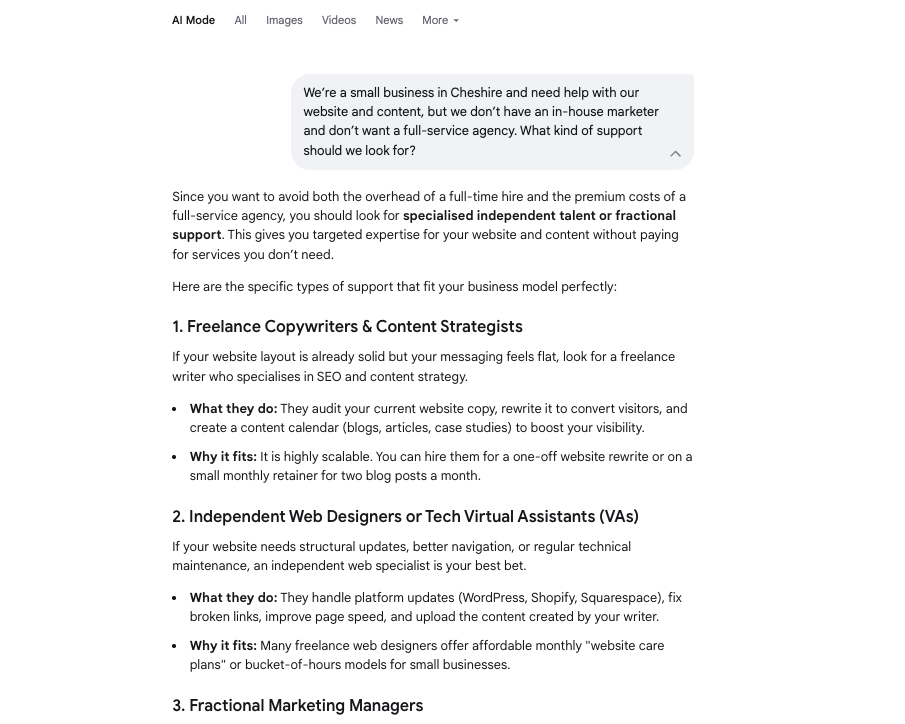
AI search queries are becoming more conversational
They can then ask follow-up questions, compare different types of support and narrow down what they need before visiting a business’s website. That means we need to think a little more broadly about visibility. We still want our websites to appear in relevant search results, but we also need to consider whether our businesses are being included in AI answers and how they’re being described, especially as AI search is much more conversational than traditional search.
What does this mean for website traffic?
If someone can get an answer directly in Google or an AI tool, they may not need to visit the website that provided the information. That means your content could be seen or used without you receiving a click, which is one reason website traffic alone doesn’t tell the whole story.
At the same time, someone who does click through may already have explored their options and have a clearer idea of what they need. That won’t be true of every visitor, but it’s another reason to look at the quality of your enquiries and sales alongside the number of visits.
For a small business, I’d use this as a reason to review the balance of your content. Helpful educational articles still have a place, but make sure your website also gives people the specific information they need to choose you, including service details, examples, pricing guidance and evidence of your work.
Does SEO still matter with AI?
Yes, it does, and this is probably the most useful place to start if you’re feeling overwhelmed by it all. Google’s guidance is clear that its foundational SEO practices remain relevant to its AI search features, so having an accessible website, a clear structure and genuinely useful content still matters.
Other platforms, such as ChatGPT and Perplexity, work differently, and being visible in Google doesn’t automatically mean you’ll appear in those tools. There also isn’t one formula that will guarantee your business gets recommended across all of them.
You might have heard people referring to AEO, which stands for answer engine optimisation, or GEO, which stands for generative engine optimisation. Broadly, these terms describe improving visibility in direct answers and AI-generated responses, and there’s quite a lot of overlap with SEO.
It’s useful to understand what those terms mean, but I wouldn’t get too caught up in the labels. For a small business, I’d focus on what will make your business easier to find, understand and trust, and whether the work you’re doing is helping the right people discover you.
Start by looking at where you are now
Before making lots of changes, take a step back and look at the visibility you already have, because you may have useful content or pages that you can build on. Google Search Console can help you see which searches your website appears for and which pages receive impressions and clicks, while your website analytics can help you understand what visitors do once they arrive.
Look at which topics you’re already being found for, whether your important service or product pages are getting attention, and which pages contribute to enquiries or sales.
You can also try a few realistic customer questions in AI tools to see what comes back. Does your business appear, is the information accurate, and which other businesses or sources are being mentioned?
I wouldn’t judge your visibility from one answer, as results can vary, but checking a small set of relevant questions over time can help you spot patterns and things worth investigating.
Make sure your website clearly explains what you do.
This might sound obvious, but it’s easy for a website to become less clear as a business grows, services change and more pages get added. If someone lands on your website, can they quickly understand what you offer, who you help, where you work and what they should do next?
Sometimes we become so familiar with our own businesses that we assume things are obvious when they aren’t, or we use language that sounds nice but doesn’t explain very much. For example, “helping you unlock your potential” could mean almost anything, whereas a specific explanation of your service and the problem it helps with gives people much more to work with.
I’d start with your most important service or product pages and check whether they explain what’s included, who the offer is suitable for, how it works and what someone might need to know before enquiring.
The SEO technical basics matter here too, including making sure important pages can be accessed by search engines, your navigation makes sense, and your page titles and headings describe the content clearly.
If your main service page is vague or your business information is out of date, sorting that out is likely to be a better use of your time than trying the latest AI visibility tactic.
Think about the questions people ask before they buy
Keywords are still useful for understanding what people search for, but it helps to think about the questions and decisions behind those searches as well.
If someone is considering a bespoke piece of jewellery, for example, they might want to know how the process works, what affects the price, how long it takes and whether they can use an existing stone. If they’re looking for marketing support, they might be wondering whether they need a consultant, an agency or someone in-house, and what each option would involve. These are useful things to address in your content because they help people understand their options and feel more confident about taking the next step.
You probably already have some of these questions in customer emails, enquiry calls and everyday conversations, and you can use search data and keyword research to build on what you’re hearing.
Rather than writing lots of disconnected posts, think about a few subjects that are relevant to your business and how you can cover them properly. You might have a main service page supported by a useful article, a case study and some FAQs, with links between them so people can find the information they need. You don’t need to create a separate page for every possible version of a question, especially if you’d end up repeating yourself.
Make the useful information easy to find
Once you know what people need to understand, make it easy for them to find the answer without having to work through lots of vague introductory copy. If a heading asks how long a service takes, give people a useful indication of the timeframe before explaining what might affect it. If you’re comparing options, a table might make that clearer, while a process might be easier to follow as a series of steps.
Clear headings and well-organised information help people use your website, and they also give search systems clearer content to interpret. One useful check is to look at an important section on its own and ask whether it still makes sense. Is it clear which service or subject you’re talking about, or does the reader need information from elsewhere on the page to understand it? You don’t need to turn your whole website into a list of questions and answers, but you do want the important information to be clear and easy to follow.
Bring your own experience into your content
With AI making it so easy to produce general information, there’s real value in including the things that come from your own experience. That might be a common mistake you see, a question you’re regularly asked, an example from your work or an explanation of why you would approach something in a particular way.
A case study can be useful here, especially when it explains the situation, the decisions you made and what happened, rather than simply saying the client was happy. You don’t need to carry out a huge research project to have something useful to contribute, but it’s worth asking what you can add that someone wouldn’t get from a generic summary of the topic.
I’d also look at the balance of content you’re creating. Educational articles can be helpful, but make sure you also have information that helps people decide whether to buy from you, such as service details, pricing guidance, comparisons, examples and an explanation of your process. And make it clear who is behind the content, with relevant experience, author information and evidence to support important claims.
Look beyond your own website
Your website is an important part of your online presence, but it isn’t the only place people can find out about your business. Reviews, professional profiles, relevant directories, industry coverage and recommendations all contribute to the wider information available about you, so it’s worth looking at the picture they create together.
For a small business, that might mean keeping your Google Business Profile up to date, asking customers for honest reviews, checking your professional listings or contributing your expertise through a relevant publication or partner. The important thing is to choose places that make sense for your business and your audience, rather than feeling you need to be everywhere.
It’s also worth checking that your information is consistent. If your website describes one set of services but an old profile lists something you no longer offer, that can create confusion. What you say about yourself matters, but genuine reviews, recommendations and independent recognition give people additional evidence to help them decide whether you’re right for them.
Give people a reason to trust you
It’s easy to describe your business as experienced or trustworthy, but what can someone actually see that backs that up?
That might be relevant qualifications, a clear explanation of your experience, examples of your work or case studies showing how you’ve helped customers. If you publish advice, make it clear who’s written it and what experience they bring to the subject, and link to reliable sources where you’re making factual claims.
There’s also what other people say about you, through genuine customer reviews, recommendations, industry recognition or mentions on relevant websites. These give someone more to go on than the claims you make about yourself.
As I explained in the webinar, credibility comes from the picture these things create together. Your website, your content and your wider reputation should help people understand what you know, what you do and why they can feel confident choosing you.
Make more use of the content you already have
This doesn’t mean you need to start producing twice as much content or add more platforms to your workload. If you’ve created something useful, think about how you could adapt it for the places where your audience already spends time. A blog post could give you material for an email, a short video or a few social posts, while a webinar can become an article, which is exactly what I’m doing here.
You’ll still need to adapt it so it works in each format, but you’re building on the same knowledge rather than starting with a blank page every time. For a small business with limited time, that’s a much more manageable way to share your expertise consistently and give people more opportunities to discover you.
Keep an eye on what it’s doing for the business
Rankings and website traffic are useful, but I’d always look at them alongside what’s happening commercially. Are you getting relevant enquiries? Are people booking, buying or asking about the services you want to sell? Are the opportunities coming in a good fit? You can also look at identifiable referrals from AI tools and other websites, and simply ask customers how they heard about you.
You won’t be able to trace every interaction, particularly if someone discovers you in an AI answer and comes back later through another route, so it helps to look at the overall picture. Being mentioned in an answer can be encouraging, but you still want to understand whether that visibility is helping your business.
So, where should you focus first?
If you’re short on time, I’d begin by checking what already brings people to your website, then choose one important page to improve. Make sure it clearly explains your offer, answers the questions someone is likely to have and includes evidence that helps them trust you. From there, you could improve a supporting article, add a useful case study or update the profiles and listings that matter most.
You can build on that gradually, using what you learn about your customers and your results to decide what deserves attention next. AI search is something to pay attention to, but you don’t need to overhaul your marketing every time a platform changes. Keeping your offer clear, your information useful and your expertise visible gives you a strong foundation to build on as search continues to evolve.
If you’d like some help working out what this means for your business, I can help you review your website and online visibility, identify the gaps and decide where to focus next. Get in touch and we can talk through what you need.
-Louise
P.S. Don’t forget to:
🔍 Find out more about my SEO and AI Visibility Audit for small businesses
🎓 Take my new course, ChatGPT Work Mode for Small-Business Marketing
💌 Sign up for my newsletter for regular, practical marketing and AI tips