Why your small business isn’t as visible online as you may think: 3 common problems
I have recently completed several SEO and online visibility audits for small businesses in different sectors. These were all different businesses, and the interesting thing was that most of them had really good foundations. However, I noticed that there were 3 main visibility problems that appeared across the audits and so I thought it would be useful to share these common issues, as well as my thoughts on why they are important.
Customer search behaviour is changing, with more people now discovering and researching businesses across Google, social platforms, and increasingly AI tools such as ChatGPT and Claude. Google also now uses AI search features including AI overviews and AI mode, and according to Google, its AI Mode has surpassed one billion monthly users just one year post launch. About 30% of searches now show AI overviews, and more than half (53%) of adults say they see these summaries often.
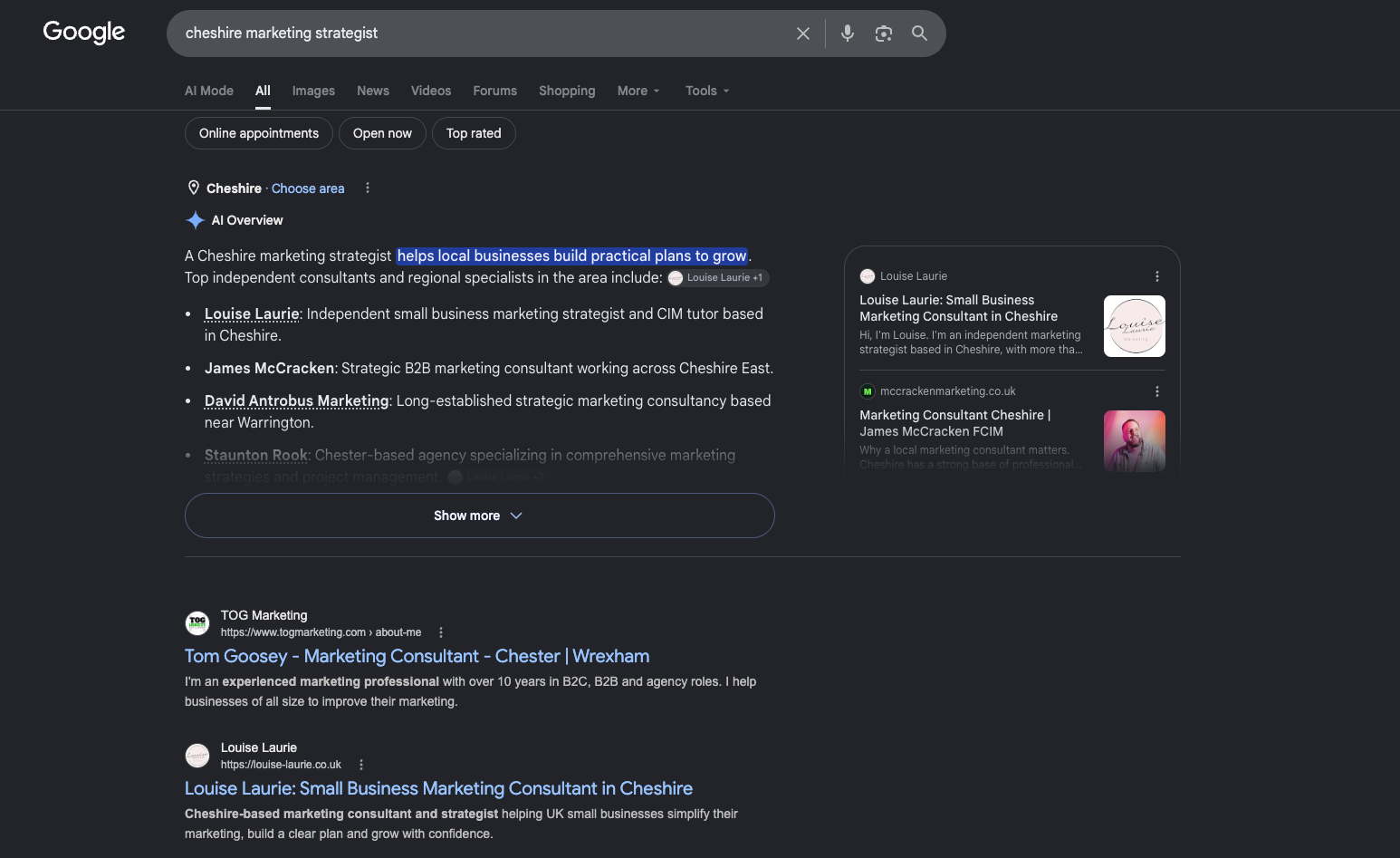
Google AI Overview Exanple - the AI Overview appears at the top of many Google search results
It’s important to take notice of this, because there are some additional factors that may affect whether AI tools and systems cite and/or recommend your business. For exampe, a business may already rank well on Google, but this doesn’t guarantee a mention in AI search results or by AI tools like ChatGPT. And AI adoption is growing - ChatGPT for example now has 1.2 billion weekly users. The crux of it is, if these platforms cannot easily understand what a business does, who it helps and why it is trustworthy, that business may be overlooked. It’s fairly basic stuff when it comes to marketing, but you’d be surprised how often the basics get unintentionly overlooked.
What does online visibility mean for a small business?
Online visibility is how easily potential customers can find your business when they search for the products, services or information you offer. This could be through Google, Google Maps, social media or AI tools such as ChatGPT and Claude.
For a small business, this means being discoverable beyond people who already know your name. For example, someone might be searching for a handmade jewellery designer, comparing local services or asking a question that your expertise could help answer.
Being found is the first step, but what people find matters too. For example, can they quickly understand what you do, who you help and where you’re based? Can they see reviews, examples of your work or other reasons to trust you? And is it clear how to buy, book or enquire?
These are the things I look at in a visibility audit. A business might already have a website and active social accounts, but there can still be gaps in how easily people can discover it, understand the offer and take the next step. The good news is that most of these areas are quick fixes, and a few tweaks can make a big impact to online visibility.
Here are 3 of the main issues I found when carrying out my recent online visibility audits:
Problem 1: It isn’t immediately clear what the business does
One of the issues I noticed across the audits was that businesses had strong offers, but they weren’t always clearly explained online. So for example, a new visitor might be able to get a general sense of the business, but still have questions about what was available, who it was for or how to enquire.
In one audit, a business offered two different services, but the distinction between them wasn’t immediately clear. In another, there was an opportunity to support the creative brand wording with a more straightforward explanation of the products and the person making them.
Things like this are very easy to overlook when you know your own business so well. You already understand what you offer and how everything fits together, but remember that somebody discovering you for the first time doesn’t have that context.
Why does clarity matter for online visibility?
Clear business information helps potential customers decide whether your products or services are relevant to them. It also gives search engines and AI tools more context about what your business does, where it operates and which questions your content answers.
For example, a distinctive phrase might communicate the feeling behind a creative brand, but it may not tell someone whether the pieces are handmade, whether bespoke commissions are available or where the maker is based. The key is to keep that personality while adding the practical information people (and search tools) need.
The same applies to individual pages because someone might arrive directly on a service or product page without seeing your homepage first, so that page needs to make sense on its own.
What can you do about it?
Start by looking at your homepage, social profiles and most important service or product pages from the perspective of somebody who knows nothing about your business.
Ask yourself:
Is it clear what I sell or what service I provide?
Have I explained who it is for?
Is my location or service area clear, where relevant?
If I have different offers, can people easily understand the difference?
Is it obvious how to buy, book or enquire?
The good news is that you don’t necessarily need to rewrite everything, but you might need a clearer opening sentence, a more descriptive heading, a short explanation of each service or a more visible enquiry link for example.
The aim here is to make sure people don’t have to piece the information together themselves. Your brand can (and should!) still sound like you, while making it much easier for someone to understand whether you can help them.
Problem 2: Your strongest trust signals are hidden
Another thing I noticed was that businesses often had valuable evidence of their expertise, but it wasn’t always visible in the places where a potential customer might need it.
By trust signals, I mean things like customer reviews, qualifications, years of experience, examples of your work and information about the people behind the business.
In one audit, an established business had a strong reputation and positive Google reviews, but there was an opportunity to bring more of that reassurance onto its product and consultation pages. In another, the owners story was a real strength, but it could have been introduced more clearly on the homepage.
The information was already there, but in many instances it was buried and so wasn’t necessarily reaching someone at the point where they were deciding whether to buy or enquire.
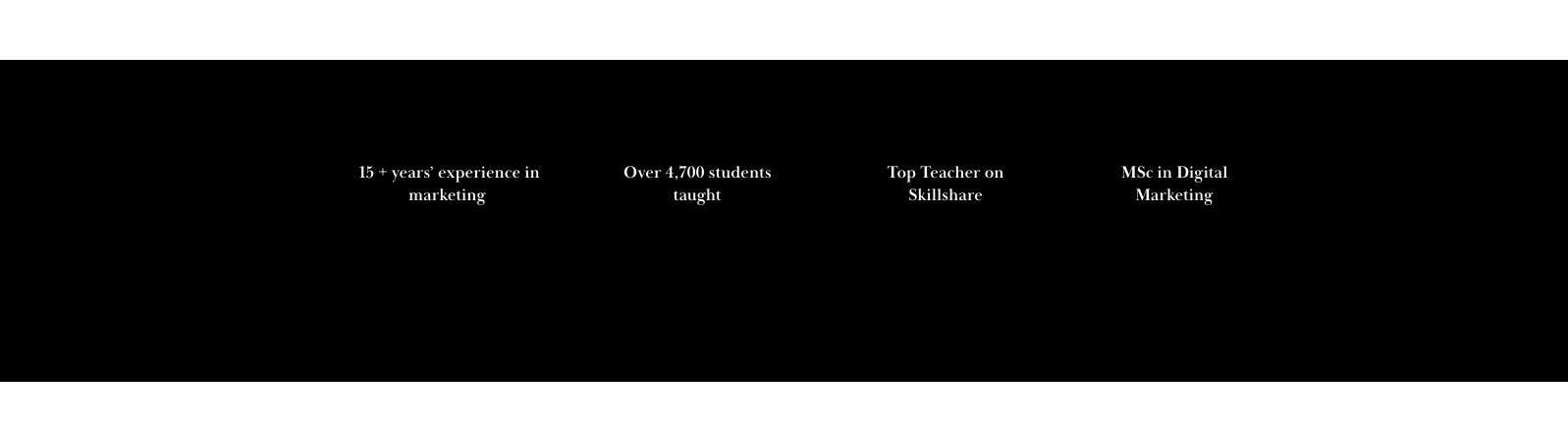
Example trust signals for my own site
Why do trust signals matter?
When somebody discovers your business for the first time, they don’t have the same confidence in you as an existing customer. They may want to know who you are, what experience you have and whether other people have had a good experience.
This is particularly relevant for a personal service or a considered purchase. Before booking a treatment or purchasing a service, for example, somebody might need more reassurance about the process and the person they will be working with.
Making that information clearly visible helps customers assess your business, but it also creates a clearer record of your experience and reputation online. That doesn’t necessarily guarantee a higher Google ranking or a recommendation from an AI tool, but it gives both people and search systems more reason to trust and recommend you.
What can you do about it?
Think about the pages someone is likely to visit before they contact you or make a purchase. What would help them feel more confident at that point?
You could:
Add relevant customer reviews to service, product or booking pages.
Explain your experience or qualifications alongside the service they relate to.
Show examples of your work, with a short explanation of the brief or outcome.
Introduce the person or team behind the business.
Explain what happens during a consultation, appointment or project.
Link to relevant case studies, professional profiles or independent reviews.
It’s also worth having a simple, consistent process for collecting feedback. One business I reviewed already had positive reviews and was asking customers for them, but not consistently. The recommendation was to make that process easier to maintain, rather than relying on remembering each time.
You don’t need to put every review and qualification on every page. Instead choose the evidence that is most useful to somebody considering that particular product or service.
Problem 3: There isn’t enough useful content beyond social media
The third issue appeared in a few different ways. Some businesses relied heavily on Instagram and third-party websites. Others already had a good website, but there were gaps in the information available to potential customers.
This might mean a service page that doesn’t fully explain what is included, a product page that leaves practical questions unanswered, or useful advice that has only ever been shared in a social post.
Why does useful website content matter?
Social media can be a valuable way for people to discover your business. Some of the businesses I reviewed were already getting bookings through Instagram, so the recommendation wasn’t to stop doing what was working.
However, a website or landing page gives you somewhere that you control to explain your business in more depth. It also gives you a lasting place for information that might otherwise become difficult to find among older social posts.
For businesses that already have a website, the question is whether it gives customers enough information to make a decision. An attractive page can still leave someone wondering about price, suitability, delivery, the process or what to do next.
Useful content helps answer those questions, so things like blog content answering common questions, or FAQs related to your products or services on important pages that support a sale. It’s also important to link related pages together, so that it becomes easier for visitors to move from researching a topic to exploring a relevant product or service. This also helps search and AI tools understand how your content links together.
What can you do about it?
Start with the questions customers already ask you in emails, messages, appointments or consultations.
Then look at where those answers would be most useful:
Could an important service page explain the offer more clearly?
Does a product page need sizing, materials or delivery information?
Would a short FAQ section help someone feel ready to enquire?
Could an existing social post become a useful website guide?
Does that guide link to the relevant product, service or booking page?
If you mainly use social media, a simple landing page might be enough to explain your services, introduce you, show reviews and provide a clear enquiry route. Equally, one of the businesses I reviewed already had an effective combination of Instagram, Google Business Profile and online booking. For that business, a website was a longer-term option rather than the first priority. This can especially be the case for small, local businesses who may rely on social media and Google Business Profile for local visibiliy.
The right starting point depends on your business, your goals, what is already working and where customers are missing information.
What does this mean for AI search visibility?
AI search visibility means whether, and how, your business appears in answers generated by AI tools and search features. That might be a mention of your business, a link to your website or inclusion in a list of suggested providers.
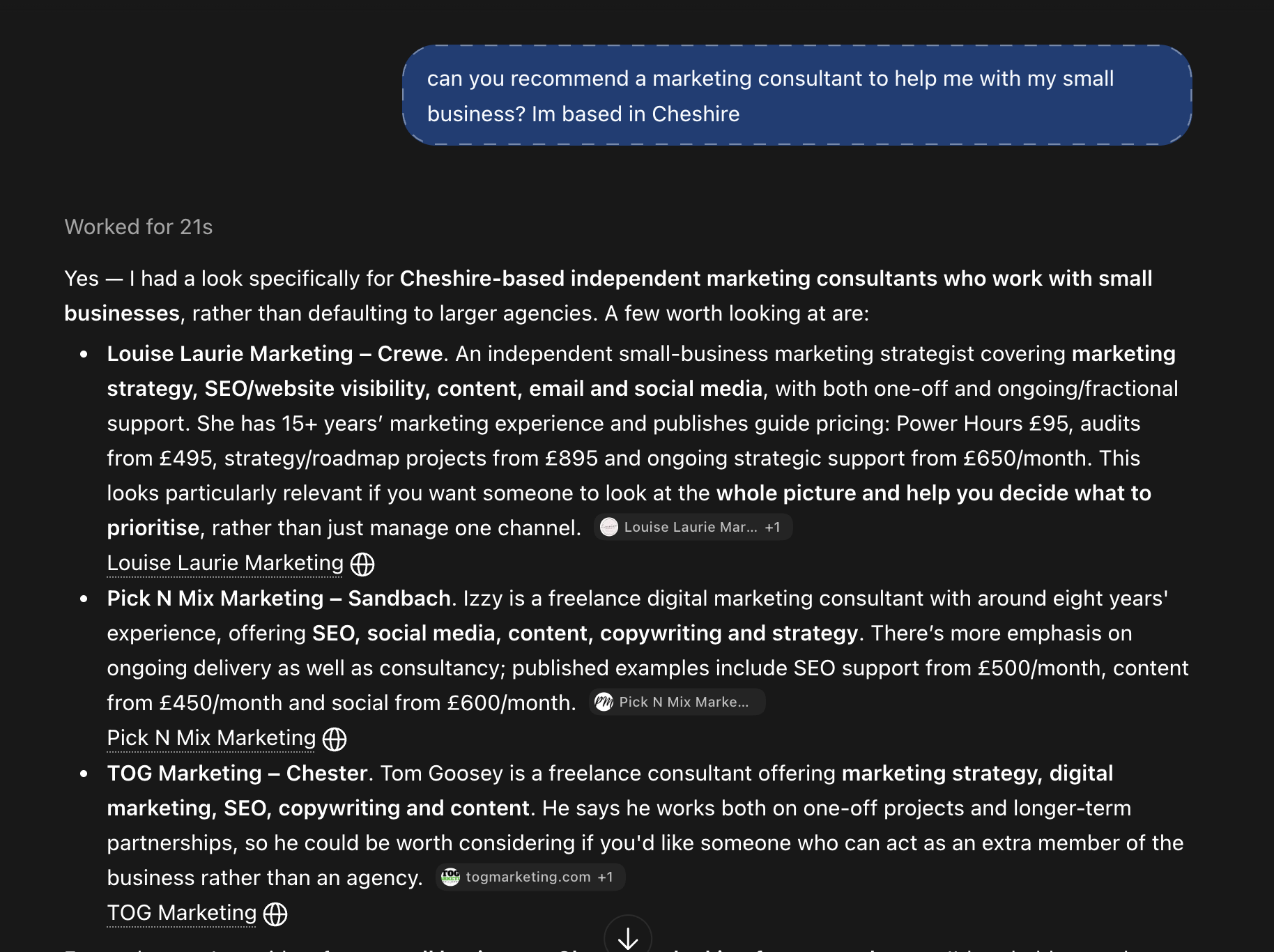
Do you know what AI says about your business?
The three issues above are relevant because they concern the information available about your business. If your services are difficult to understand, your expertise is barely mentioned and important questions go unanswered, there is less useful material for a search system to draw on, and you are less likely to be cited or recommended.
However, it’s important not to treat these improvements as a formula for getting recommended by ChatGPT or appearing in a Google AI answer. The question someone asks, the sources a system uses and other factors all affect the response. Unfortunately, there is currently no magic formula for being recommended by AI search and tools, however having strong foundations will give you a much better starting point.
To begin, make sure your business is clearly explained, your useful information is accessible and your experience is supported by evidence. Those improvements have value for potential customers too.
How can a small business improve its online visibility?
Start by making sure your online presence clearly explains your business, shows why people should trust you and helps them take the next step. Based on the audits, these are the areas I would focus on:
Make your offer clear. Explain what you do, who you help, where you work if relevant, and how someone can buy, book or enquire.
Make your strongest proof more visible. Bring relevant reviews, experience, qualifications and examples of your work onto the pages where people are considering your services or products.
Strengthen your most important pages. Start with the service, product or booking pages most closely connected to your business goals. Check that they are clear and accurate, and that they give people enough information to make a decision.
Answer genuine customer questions. Use the questions you receive in conversations, emails and messages to improve your pages, add useful FAQs or create a helpful guide.
Connect your content. Make it easy for someone reading an article or exploring a product to find the relevant service, further information or enquiry page.
Build visibility beyond one social platform. Keep using the channels that work, but consider where a website, Google Business Profile or relevant directory listing could give people (and AI tools) another way to discover you.
Check your technical foundations and measurement. Make sure important pages can be found and indexed, and use website and enquiry data to understand what is working.
Most small businesses won’t need to do all of this at once. Choose the improvements most relevant to your goals and the gaps in your current online presence. For example, a clearer service page or a better booking journey may be a more useful starting point than committing to lots of new content.
You may already have more to work with than you think
The encouraging thing about these audits was how much the businesses already had in place.
There was already experience, strong customer feedback, distinctive products and useful knowledge. Often, the opportunity was to communicate those strengths more clearly and make them easier to find across the customer journey.
So before you decide you need a new website or another social platform, take a look at what you already have. Are you explaining it clearly? Are people seeing your strongest evidence? And are you answering the questions that would help them take the next step?
If you’d like help understanding where to focus, I offer SEO and AI visibility audits. I can review how easily people can find and understand your business online, identify gaps and provide a clear, prioritised 90 day plan based on your goals.
You can find out more or get in touch through my website enquiry form.
-Louise
P.S. Don’t forget to:
🔍 Download the free ChatGPT Work mode workflow guide
🎓 Take my new course, ChatGPT Work Mode for Small-Business Marketing
💌 Sign up for my newsletter for regular, practical marketing and AI tips